

In our beginner courses the question with which camera settings one photographs the (full) moon comes up again and again. The participants almost always think that you need a high ISO number and a long exposure time for this. This seems to be quite logical at first. After all, the moon mostly catches our eye at night and at night it is known to be dark. But a closer look reveals exactly the opposite.
The correct exposure
First of all: During a full moon at night, i.e. when the sky is pitch black, the camera’s exposure measurement will in most cases give a wrong or at least not quite correct result. Why this is so will be explained further down. Those who rely on the automatic will almost always have a completely overexposed full moon in the picture. This surprises many beginners in photography and even some older hares who have not thought about the problem.
The moon is illuminated by the same sun as the earth. In principle, this is clear to everybody (ok, a few flatheads don’t know this, but it has nothing to do with photography … ). But many photographers do not draw the right conclusion. If the sun is the same and the distance from the sun is the same, then it is just as bright on the moon as on a cloudless day on earth (since the moon has no atmosphere to scatter the light, it is even a little bit brighter there than on earth). In other words, the age-old “sunny 8 rule” applies. Now you might say “All right, f8 is fine, but what about the ISO number and the shutter speed?” It’s simple. The ISO number and shutter speed are about the same as on Earth on a sunny day. This results in a proper exposure of the full moon at night with about
ISO 200, f8, 1/125 s
You don’t believe that? Then just try it. Or you can look at the following picture and believe me, that I don’t want to pull your leg:
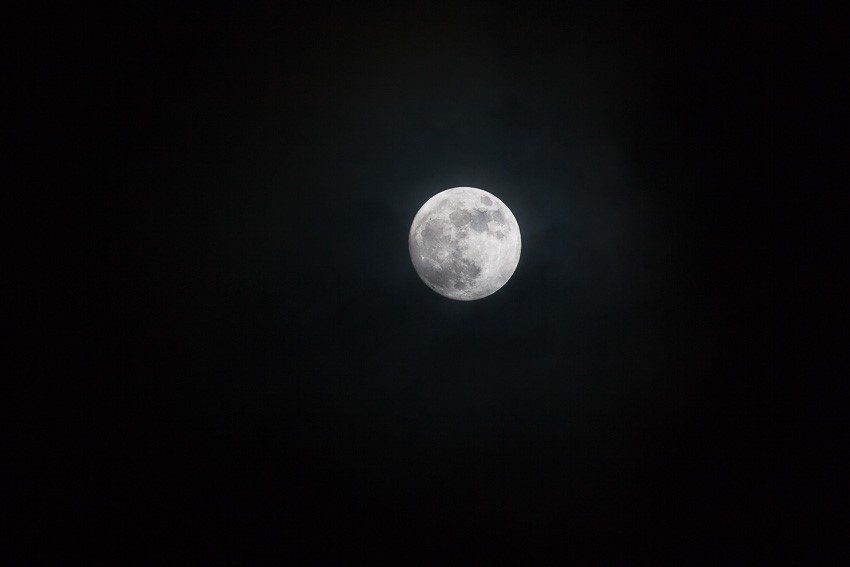
ISO 200, f8, 1/125 s
Don’t nail me to the 1/125th second. Even with a 1/160 s or with 1/80 s you will still get a good exposure. So in any case you can take a picture of the full moon from the hand without any problems.
Important: These exposure data are only valid for a clear sky. As soon as a slight veil cloud has formed, all this is no longer true. Logically, clowds swallow a considerable amount of the light. The following picture was taken when the sky was covered by light clouds.
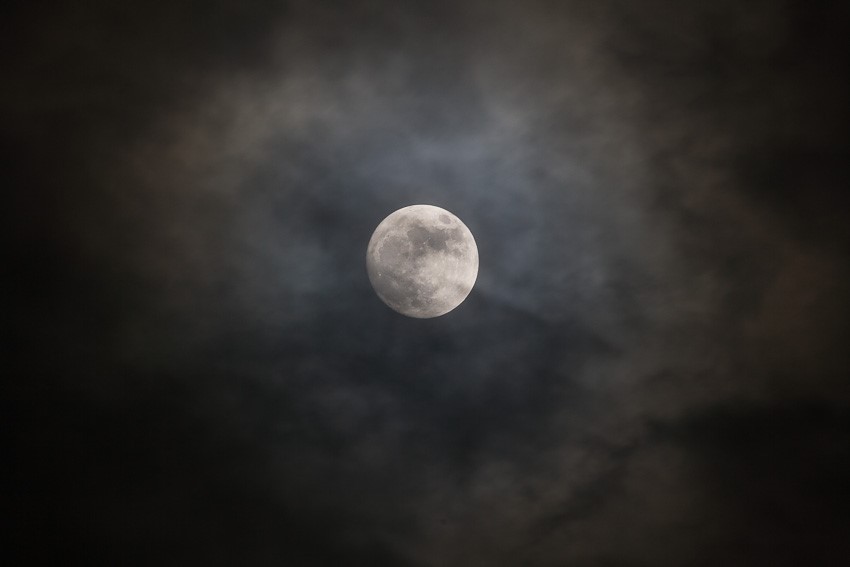
ISO 200, f5.6, 1/4 s
The difference in the exposure data is quite drastic. Handheld shooting is now impossible.
Contrast
The two pictures above show only the full moon in a dark environment. But as soon as the moon and a foreground are in the frame, the contrasts usually become so high that the moon is normally overexposed. The photo of Lismore Castle clearly shows the problem:
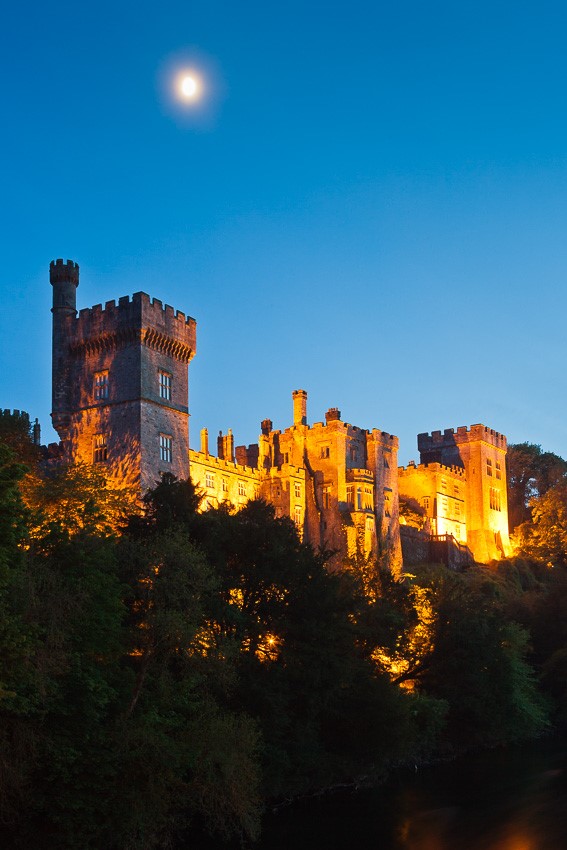
ISO 200, f11, 20 s
An exposure time of 20 seconds was required for correct exposure of the illuminated castle. A multiple of the correct exposure time for the moon. Consequently the moon is only a blown out, structureless spot in the sky.
Exposure metering at full moon
Since the full moon is relatively small, the image area of the shot is dominated by the black sky at normal focal lengths. The center-weighted integral and the matrix metering methods inevitably result in an overexposure of the moon.
The spot metering directly on the moon improves the measuring result. However, since the moon appears much brighter than medium grey, spot metering results in a somewhat too dark image.
The focal length
If we look at the moon with the naked eye, it appears relatively large to us. At a medium focal length, however, it is surprisingly small. The following picture was taken with a focal length of 200 mm on a full frame camera:

200 mm Focal Length on Full Frame Camera
Even with a focal length of 700 mm it is still not possible to get a full format image of the moon with a full frame camera:
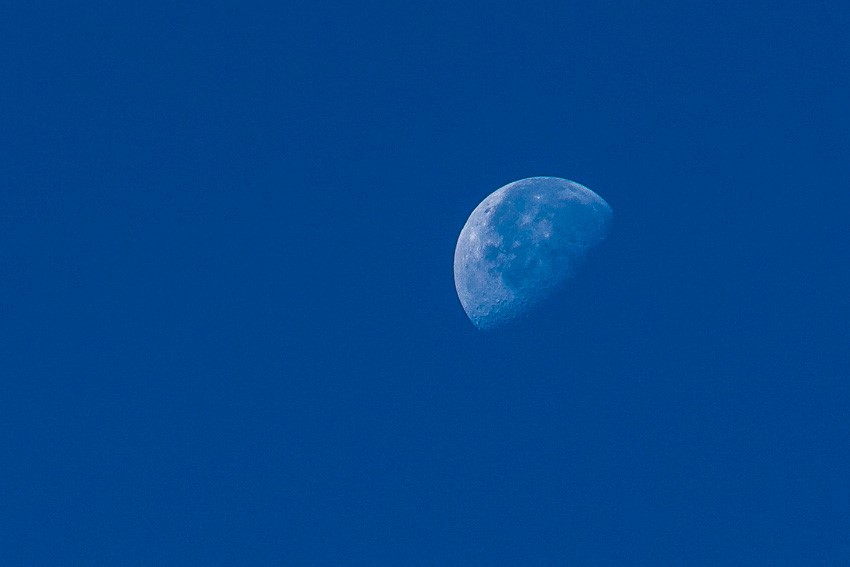
700 mm Focal Length (500 mm + 1.4x Extender), Full Frame
The featured image …
… is of course a composite. I’m sure you already guessed that, but I didn’t want to leave the picture uncommented. It’s Puxley Manor near Castletownbere, Co. Cork, Ireland.

Leave A Comment