

In part 2 of this series we talked about the flash synchronization speed and why you can’t use a flash at shutter speeds faster than the flash sync speed. However, sometimes very short exposure times when using flash are unavoidable. Todays featured image is an example. In this portrait of a masked person the bright sun in the background and a large aperture (f2.8) for a shallow depth of field resulted in an exposure time much shorter than the cameras flash sync speed of 1/200 s. Without fill flash though the mask would have been way to dark. That’s when High Speed Synchronization comes in.
How High Speed Sync (HSS) works
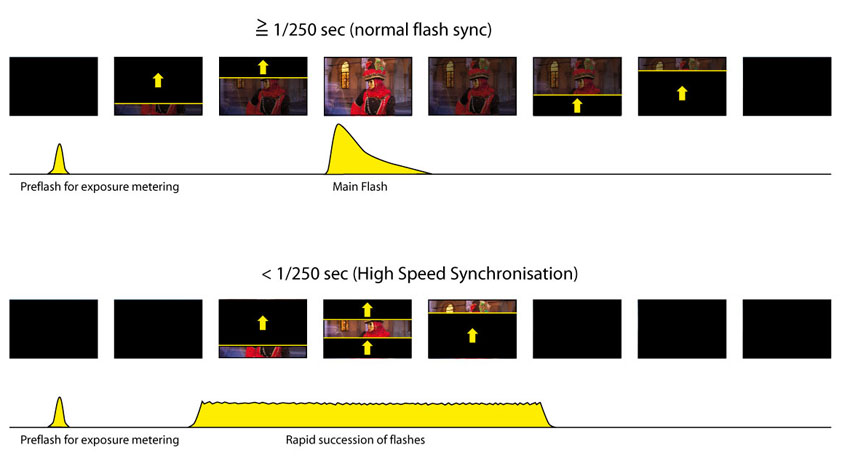
Let’s just shortly recall how a normal flash works. Immediately before the shutter starts to open, a very short preflash fires. This preflash is used exclusively for exposure metering. Once the shutter is fully open the main flash fires and the picture is exposed.
For very short exposure times this doesn’t work anymore as the shutter is never fully open. Therefore when High Speed Sync is activated, the flash fires a series of flashes in rapid succession and almost works like a permanent light source. See the illustration below.
You could argue that High Speed Sync is great and that it should always be activated. Actually in many cameras it is the default setting. However, High Speed Sync has some drawbacks that you should be aware of:
- The flash power is drastically reduced because the flash has to fire a series of flashes instead of on high power flash
- The batteries are drained much faster than in normal flash mode
- The flash can get quitte hot and may stop working until the temperature is down to a lower value
As long as you are aware of this limitations it’s fine to use HSS. However, we prefer to use it only when absolutely necessary.

Leave A Comment