
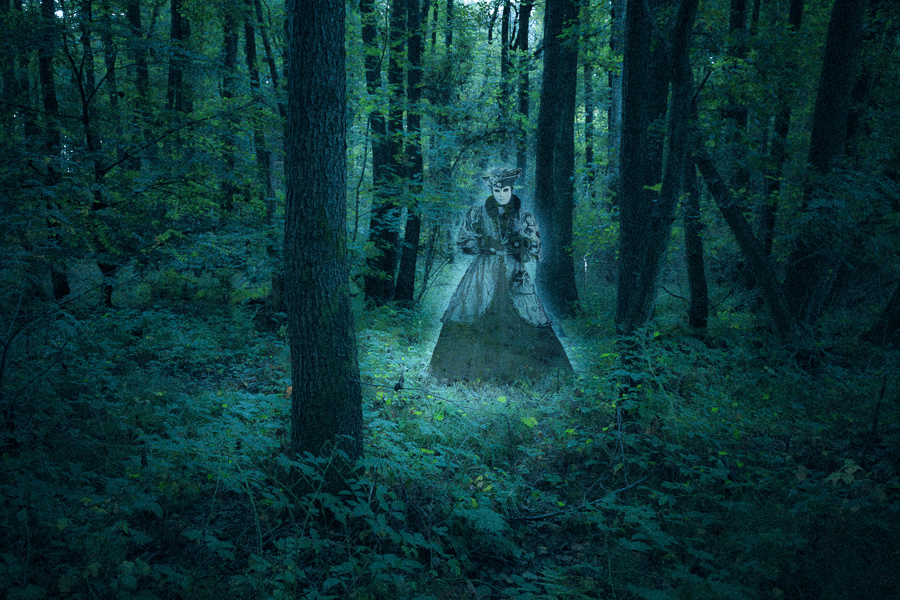
There are different opinions about phantoms. One is convinced that they exist, the other smiles at the idea. To say it straight away: The phantom of diffraction blur really does exist. It lives in every lens. It usually remains hidden and only rarely appears. But then it shows its ugly face on the photo. But it is mostly harmless*. That’s why you can smile about it. That’s why you should smile about it!
Diffraction blur?
If your seventh grade physics class has faded a bit, then the term “diffraction blur” may not be so present. Among (amateur) photographers, however, diffraction blur seems to be a ubiquitous bogeyman. For those of you who don’t know what it means, here’s a brief, simplified explanation:
When light passes through a very narrow slit, it is deflected or “diffracted”. It deviates from the “right path,” so to speak. What does this have to do with photography? Well, at very small apertures, the light is diffracted by the aperture and a point is actually no longer depicted as a point, but as a small disk. The result is a certain blur that runs through the entire photograph. Diffraction blur must therefore not be confused with insufficient depth of field!
But the average photographer doesn’t want blur. Ergo: He avoids small aperture openings like the bubonic plague. Experts differ in their opinions about the f-number at which diffraction blur becomes visible. But those who want to be safe shy away from f/11. Even at f/8, some photographers already have a stomachache.
But everyone knows that the smaller the aperture (the larger the f-number), the greater the depth of field. And that’s where the dilemma of the above-mentioned photographers begins…
Depth of field or no depth of field, that is the question**
With many subjects, you want complete depth of field. Landscape shots in particular are often unsatisfactory if the foreground or background is not properly sharp. Depending on the focal length of the lens, however, this may require f/16 or f/22. Sometimes even f/32 (some people turn away with a shudder…). But if you shy away from these apertures because you fear the phantom of diffraction blur, you’ll just have to live with shallow depth of field. Personally, I’d rather put up with the slight diffraction blur at high aperture numbers than insufficient depth of field for subjects that require complete depth of field.
This photo from the Ilse Valley in the Harz mountains in Germany required, in my view, f/22 for complete depth of field:

In fact, the unsharpened RAW file shows a slight blur, as can be clearly seen in the 100% crop:

But even a slight sharpening in Lightroom, which is also useful for many other files, eliminates this small problem:

Objektiv: Canon 24-105mm / 1:4 L IS USM at f 22
Conclusion: For me (and for our photo agencies) the sharpness is sufficient. So I’m not afraid of the phantom of diffraction blur!
As always I’m looking forward to your comments.

Leave A Comment