
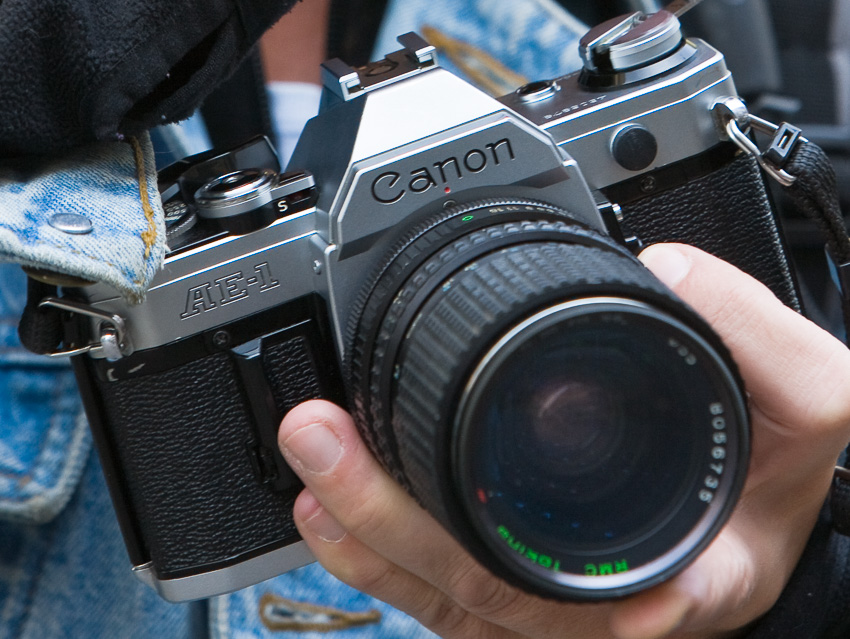
When you give a lot of photography courses, you are of course often asked for purchasing advice. This always brings Simone and me into a conflict of conscience. On the one hand, we would of course like to help, but on the other hand, we don’t feel able to give sensible purchasing advice. And that has a few simple reasons.
Is lens X better than lens Y?
To this question often asked by participants in photography courses, I can only answer, “How would I know?” Contrary to what some may think, we are not equipment junkies. We only get interested in cameras, lenses, or accessories when we need to replace our current gear for some reason (defect, loss, etc.) or when a new piece of equipment is technically so much better than our old one that it makes our job much easier (the last time this happened was when we switched from analog to digital…). Otherwise, we use what we have.
Unfortunately, we are not among the photographers who are regularly supplied with the latest cameras and lenses by the manufacturers so that we can report on them positively…
In other words: We do not have an overview of the market and cannot make any statement about the respective quality.
But we can give the criteria we use to guide us when we buy new equipment.
Camera body
Fortunately, the camera is the least important thing when taking pictures. And since even entry-level cameras have more than 16 million pixels, the number of pixels is no longer a real criteria. All manufacturers today have cameras in their product range that meet the highest quality standards. Therefore, you can concentrate entirely on the important questions:
- How does the camera feel in the hand?
- Are the controls logically arranged?
- Are the important controls large enough to be operated blindly?
- For mirrorless cameras: Is the viewfinder high-resolution and flicker-free?
- Is the menu navigation simple and logical?
- Are there accessories from third-party manufacturers?
Once you have decided on a system, however, these questions are rather academic, since you are usually committed to one of the manufacturer’s models when buying a new one.
Lenses
The lenses, more than the camera itself, determine the image composition possibilities. Therefore, you should ask yourself the following questions before buying a lens:
- What focal lengths do I need (more wide-angle or more long focal length)?
- Zoom lens or fixed focal length?
- Do you prefer a universal zoom (one lens that is always on your camera) or several lenses?
- Special lenses like Macro or Tilt/Shift?
- Are there cheaper alternatives from other manufacturers in the desired focal length range?
The answer to these questions depends very much on one’s own preferences. Those who don’t like to lug around a lot of equipment will tend to opt for a universal zoom and against several fixed focal lengths. Those who value the best imaging quality may prefer fixed focal lengths, and so on.
Tripod/Tripod head
Making recommendations for tripods and tripod heads is particularly difficult. Ultimately, it always comes down to a compromise between size, weight and price. However, two general pieces of advice can be given:
- Get advice from your trusted retailer and try it out (and then buy it there too!)
- Buy the best that you can still justify in terms of price to your significant other.
The second piece of advice in particular is often ignored. Everyone spends a lot of money on cameras and lenses, but people like to save money on tripods and tripod heads. Experience shows, however, that you won’t be happy with a cheap tripod. A good tripod, on the other hand, will survive the next five to ten camera generations. The same applies to the tripod head.
Flash
The simple advice here: The most powerful flash unit you can afford is also the best. You never have too much light, but often too little. A guide number of 40 or more is therefore a good idea.
Cable / remote release
The cable or remote releases of the camera manufacturers are overpriced! Third-party suppliers can do this much cheaper and just as well.
Filter
You can’t go wrong with the brand name filters. You buy a filter with the thread diameter for the largest lens you own. For lenses with smaller diameters, you buy the corresponding step-down rings. This way you can use one filter for all lenses. The alternative to screw filters are plug-in filters with a corresponding lens attachment.
By the way, UV filters are useless.
Consultation in specialized shops
When it comes to specific brands and specific devices, the specialist retailer is still the right contact. We can only give general advice, because with the best of intentions we cannot know all cameras, lenses, etc. personally.

Leave A Comment