
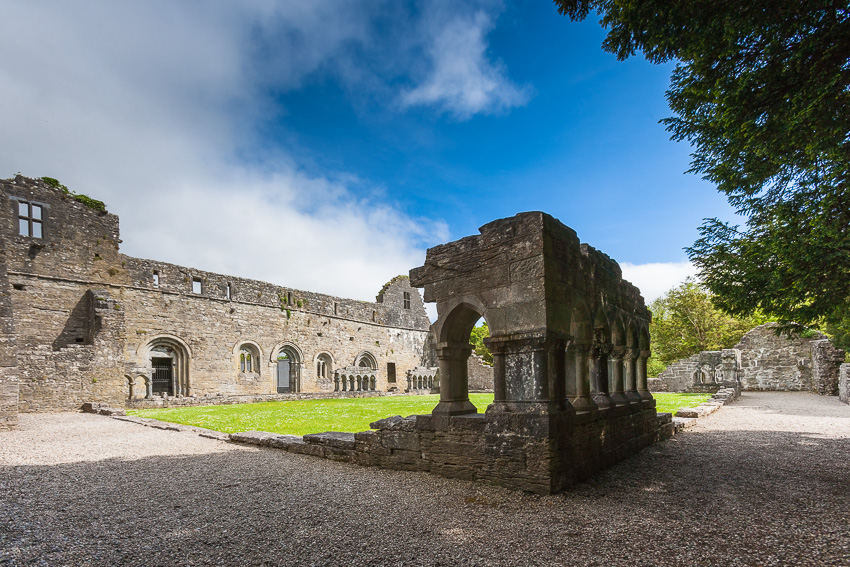
Whenever the contrast of a scene is higher than the dynamic range of the cameras sensor, i.e. the ability of the sensor to capture detail in the highlights and the shadows at the same time, High Dynamic Range or HDR photography is the solution. HDR photography usually requires the use of a tripod. However, it is possible to do it hand-held. This is how it works.
What is Dynamic Range?
Dynamic range is the ability of the sensor to reproduce the contrast range of a scene without losing detail in the highlights and shadows. If we assume that the sensor. Assuming that the sensor can record a contrast range of 12 f-stops between the very bright and very dark parts of the scene, a contrast range of 14 f-stops would result in clipping of the lights and/or shadows. Each sensor has a certain dynamic range, depending on the technology involved. Every new camera generation usually has a slightly better dynamic range, but it is limited nevertheless.
A brightly lit scene and especially when shooting into the sun often exceeds the dynamic range of even the most advanced digtital sensor. By comparison the human eye has a much greater ability to record high contrast scenes. That is the reason why we are often disappointed of photographs of those subjects.
What is HDR-Photography?
Most of you probably know what HDR-Photography is but it won’t hurt to explain it briefly.
When the contrast of a scene exceeds the dynamic range of the sensor you can simply take three, five, seven or more pictures with different exposure settings. The number of pictures you need depends on the contrast of the szene. The higher the contrast the more pictures are required. For the sake of simplicity let’s assume, that three exposures will do the job (actually more often than not three exposures will do). In that case you start with a frame that is underexposed by, let’s say, two f-stops, followed by a frame with a “normal” exposure and one that is overexposed by two f-stops.
Note, however, that you shouldn’t actually change the aperture when shooting the three frames. Instead use a fixed aperture, let’s say f8, and use different exposure times. The reason is that different aperture settings would result in different depth of field which would pose difficulties when the shots are combined later.
The exposure settings could be like this:
- Frame 1: 1/1000 s at f8 ( -2 stops)
- Frame 2: 1/250 s at f8 (+/-0 stops)
- Frame 3: 1/60 s at f8 (+2 stops)
The resulting shots would the look like this:

These images are then combined in a special software (actually not so special anymore as many editing programs can process HDR images these days) that uses the highlight areas of the underexposed, the shadow areas of the overexposed image and the midtones of the “normally” exposed image to create a new image that covers the complete contrast of the original scene.
Ideally you should use a tripod so the different images can be superimposed without problems. However, you can try shooting hand-held.
Shooting hand-held
The problem of shooting HDR images hand-held is of course camera shake. If the framing of the individal pics due to camera shake is very different the images can not be properly superimposed. In order to minimize camera shake just do the following:
1: Set the camera to aperture priority (A, Av). This ensures that the depth of field is identical in all pics
2: Set the camera to continous shooting (the higher the frame rate the better)
3: Set the camera to Auto Exposure Bracketing (AEB)

4: Select the number of frames and the exposure bracketing (-2, +/-0, +2 in the screen shot above)
5: Press the shutter button and let the camera do the rest
This gives you three pictures with different exposures that in most cases can be properly processed by any HDR capable software.
Simple, isn’t it?

Leave A Comment